

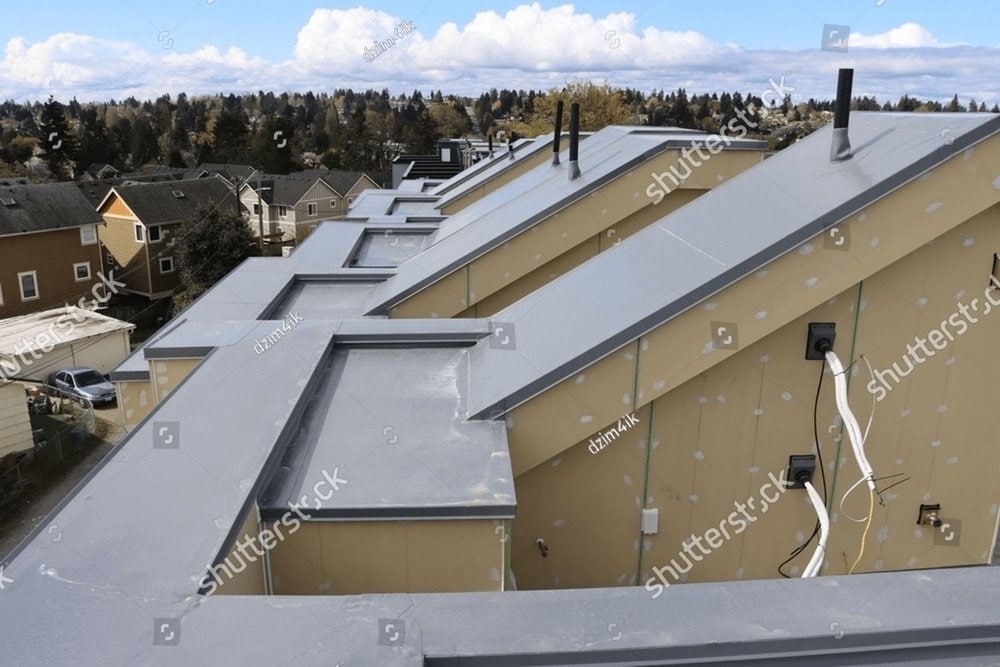
Modern construction faces increasing demands in both functionality and design. One example in particular, a state-of-the-art roofing system at Swedish Issaquah Hospital in Washington State, demonstrates how modern innovations and technology help meet challenging functionality, sustainability, and aesthetic demands. Read on to learn all about unique detailing challenges and how to approach them with modern roofing solutions.
Parapets in the Twenty-First Century
An ancient design element, the parapet has been adapted and updated to address unique detailing challenges in both new construction and retrofits. Parapets date back to ancient Mesopotamia, where they provided defensive cover, and were ultimately modified by the Greeks and Romans as architectural aesthetic building elements. The Renaissance further promoted parapets' transition from defensive to design functionality.
Fast-forward to the unique detailing challenges of urban architecture in the twenty-first century. Today, parapets often play a key role in helping keep building interiors dry and promoting sustainability and energy efficiency. In fact, a parapet is often an essential element of waterproofing for flat rooftops.
Turning up the roofing system approximately eight inches at any location on a roof where a vertical penetration occurs, such as a pipe, adjacent wall, or another parapet, helps direct the flow of water to the drains at the perimeters of those flat edges. Proper detailing at these transitions helps ensure any water that would otherwise pond or run over the edges of the building don't infiltrate the building envelope.
Liquid-Applied Flashings
In general, flashing materials should match the type of roofing membrane to ensure proper adhesion and sealing. Whether it's a built-up roof or a modified bitumen roof, the optimal approach is to use an asphalt modified bitumen membrane that's compatible with an asphalt membrane.
The same goes for thermoplastic polyolefin (TPO) or polyvinyl chloride (PVC). When installing a roof with a PVC membrane, the flashing membranes used to seal around penetrations are going to primarily be made of PVC; if using a TPO membrane, the flashing membranes will be made of TPO. Liquid-applied flashings are an innovative solution for detailing and waterproofing areas with irregular shapes, as they can conform to the contours of virtually any surface to create a seamless membrane.
Unique Detailing Challenges in Urban Architecture
Rooftop flashing details should be specified based on construction features, such as where the roof and walls of a building aren't connected, rather than by the building's geography. For example, details for modified bitumen are not differentiated between Texas and Minneapolis. What matters more than the weather or climate is the need to accommodate differential movement in construction.
To illustrate this critical point, visualize a wall passing a roof deck, with the roof moving in a horizontal mode and the wall moving in a vertical mode. In this case, it's crucial that the flashing be flexible enough to allow for slight variations in movement to help prevent tears and leaks.
Multiple Vertical Elements
Commercial rooftops with various vertical protruding elements present another complicating factor. Roofs often have a number of vertical pipe penetrations, such as vent stacks or structural supports. Structural supports are typically fairly easy to flash with pre-manufactured boots for PVC and TPO. And while they present more of a challenge, a modified bitumen membrane can often be used for flashing vertical circular pipes. Elements with more intricate details or irregular penetrations, however—such as a roof with an unusually shaped piece of metal and an I-beam—call for liquid-applied systems.
Siplast PMMA liquid-applied waterproofing systems offer an innovative solution to flashing various types of vertical protrusions and surfaces that are otherwise difficult to flash.
After priming the surface as necessary, PMMA is applied with a brush or roller in a three-step procedure. The first step to creating a highly durable, well-formed liquid-applied flashing is putting down the material, ensuring that it reaches edges, crevices, corners, and other spots that can be easy to miss. The second step is applying a reinforcement layer to add strength, cutting it into pieces to fit specific spaces and avoid clumps or overlap. The final step is applying another layer of PMMA. Because the application creates a chemical cure, the process can be completed in just a few hours.
Parapets at the Juncture of Two Buildings
Another challenging aspect of urban design involving parapets occurs at the juncture of two buildings of unequal height. For example, imagine a two-story roof that abuts a four-story building, with a horizontal roof plane, a vertical wall, and a second vertical wall (the parapet), essentially creating a two-story wall with an inside corner at the juncture of the two buildings.
Regardless of whether the two-story roof is for new construction or a reroofing project, the problem is the same: three individual planes coming together with multiple potential points of vulnerability to water intrusion. The challenge is ensuring that the water that comes down the wall flows appropriately and doesn't run behind the flashing membrane, under the roof, and into the building.
Fortunately, sheet goods and liquid-applied materials can work well in addressing this situation. Done properly, this method involves removing a small section of the wall surface to ensure the location where the vertical wall water control intersects the roofing, which intersects the parapet, is overlapped and sealed correctly.
While PMMA liquid-applied flashing is a viable solution, proper installation can be relatively pricey. However, attempting to cut corners to reduce upfront expenses can lead to costly consequences. Skipping critical steps, such as failing to remove necessary portions of the wall or properly tie the system into adjacent materials, can result in more leaks, ultimately requiring expensive rework. In some cases, improper installation may even lead to legal disputes or liability issues.
Siplast Solutions at Swedish Issaquah Hospital
Swedish Issaquah Hospital in Washington State, which treats more than 200,000 patients annually, serves as a shining example of unique detailing solutions at work. In this project, Siplast was tasked with providing a state-of-the-art roof system required to meet pristine hygiene standards and protect vital equipment for a world-class, acute-care medical facility—all on an accelerated schedule to complete construction before the onset of winter.
The solution integrated multiple elements including a vegetated roof and open plazas designed to provide an inviting outdoor environment. The main roof was constructed with Siplast Paradiene 20 EG/30 FR TG and liquid-applied Parapro PMMA flashing. Pedestrian areas were waterproofed with a protected Paradiene 20 EG/20 TG system with a paver overburden, while vegetated roof areas were waterproofed with Teranap.
The finished project features a combination of white and green roofing systems, along with walkable pathways integrated into the rooftop design. It serves as an excellent example of multiple effective sustainability strategies and well-executed detailing elements coming together to create a durable, long-lasting roof system.
