
Thermal bridging is a subtle but powerful force undermining the performance of modern building envelopes. Even in assemblies packed with high R-value insulation, conductive materials can create hidden "short circuits" for heat to escape, dramatically reducing the assembly's true thermal resistance. As codes and standards push toward higher efficiency and continuous insulation, understanding how these bridges form, and how they erode effective R-value, is essential. This article explores why thermal bridging remains one of the most persistent challenges in envelope design, how standards are evolving to address it, and best practices to help project teams close the gap between theoretical and real-world performance.
Thermal Bridging and "Effective" R-Values
Thermal bridging occurs when a material with high thermal conductivity, such as metal fasteners, studs, or structural elements, creates a path of significantly less resistance for heat flow through an otherwise well-insulated envelope assembly. While the nominal R-value of an insulation layer might suggest strong thermal resistance, any material "bridge" across or through that layer can significantly reduce the wall's effective R-value. The effective R-value accounts for all heat transfer paths in the assembly, including framing members, window perimeters, or penetrations. For example, a 2x6 steel stud wall with members spaced 16 inches on center with R-19 batt infill insulation might have an effective R-value near R-7. As such, the effective R-value is a better indicator of a building assembly's actual thermal performance—not the insulation's nominal rating.
The Challenge of Achieving True "Continuous Insulation"
The more continuity throughout a building envelope's thermal barrier, the less thermal bridging and better effective thermal resistance. Contemporary model energy codes and standards seek to mitigate thermal bridging by promoting "continuous insulation" (c.i.) strategies. ANSI/ASHRAE/IES Standard 90.1: Energy Standard for Sites and Buildings Except Low-Rise Residential Buildings is a prime example of such a model. Standard 90.1 is widely referenced as a technical foundation across many state and municipal building codes, as well as voluntary standards such as the Leadership in Energy and Environmental Design (LEED) v5 rating system.
In the 2022 edition of Standard 90.1, ASHRAE defines continuous insulation as "insulation that is uncompressed and continuous across all structural members without thermal bridges other than fasteners and service openings. It is installed on the interior or exterior or is integral to any opaque surface of the building envelope." Stated differently, continuous insulation can be described as a thermal barrier that extends unbroken across all structural elements, covering exterior walls, floor slabs, and roofs, except where penetrations are unavoidable.
In practice, achieving continuous insulation is deceptively difficult. Frankly, it is more of an aspirational concept than achievable outcome because no thermal barrier solution can achieve pure continuity.
Types of Thermal Bridges
There are two basic types of thermal bridges. Standard 90.1-2022 explicitly calls out linear and point thermal bridges (in Section 5.5.5) and provides pathways to account for or mitigate them.
Linear thermal bridges: These occur along a line in the building envelope where one assembly meets another (e.g., wall-to-roof, slab-to-wall, window frame perimeters, parapet).
Point thermal bridges: These occur at discrete, localized points in the envelope where insulation is penetrated or bypassed (e.g., fasteners, structural ties, anchor bolts, small penetrations) rather than a line of intersection.
Common Sources of Thermal Bridging in Building Envelopes
The following are common ways in which project teams may encounter thermal bridges in building envelope assemblies:
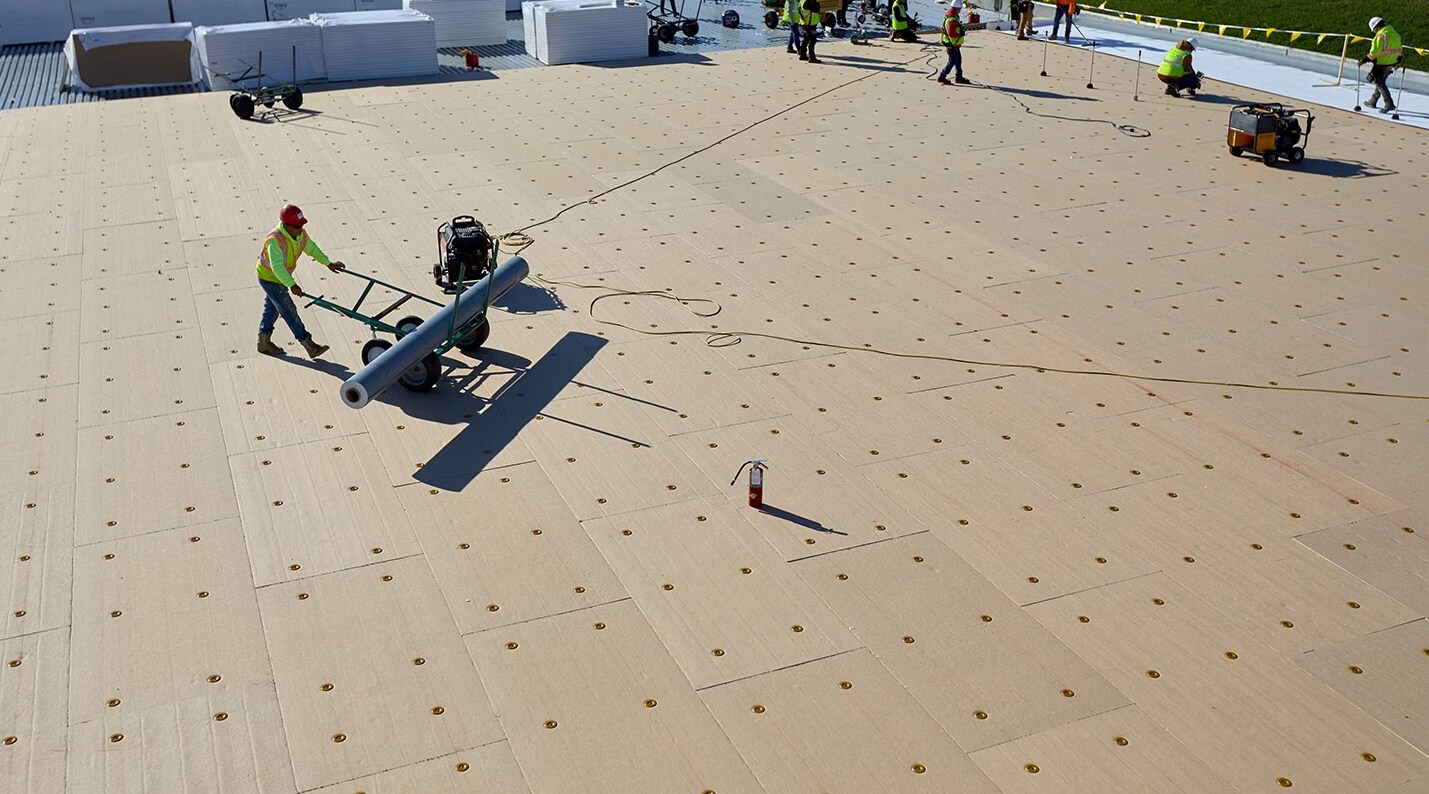
Mechanical fasteners and attachments: Even small steel screws, anchors, or cladding clips can act as point thermal bridges. When hundreds or thousands are used for, say, a facade attachment or roof insulation fastening, the cumulative effect can degrade performance significantly. Designers often overlook this when specifying fasteners or anchors, which cut through insulation layers to secure an assembly.
Transitions and interfaces: Corners, roof-to-wall intersections, balcony penetrations, and window rough openings are common locations for thermal bridges. Aligning insulation layers across these junctions can be complicated and often clashes with structural or waterproofing priorities. For example, a slab edge or parapet typically interrupts the continuity of a thermal barrier and detailing a thermally sufficient connection that remains durable and buildable is a persistent challenge.
Construction tolerances and workmanship: Even when drawings exhibit continuity, in-field practices may differ. Gaps between boards, misaligned batt insulation, and poorly sealed joints each allow air infiltration and convective looping that reduce insulation effectiveness. Trades working in sequence, such as framers, cladders, and roofers, must coordinate carefully to maintain alignment and continuity. Overly simplistic methods of calculating the effective R-value of an assembly neglect this consideration.
Structural support and code requirements: Building codes often require structural attachments (e.g., for seismic restraint or wind resistance) that penetrate insulation layers with considerable frequency. Appropriately, structural and life safety requirements take priority. Balancing these requirements with thermal continuity mitigation strategies require an integrated design process and, when possible, advanced solutions such as structural thermal breaks.
Raising the Minimum Standard
Successful mitigation of thermal bridging is enhanced through holistic coordination between design intent, materials, detailing, construction sequencing, and field verification—the foundation of which is established by a project's minimum standard. For example, with consideration of the aforementioned challenges, the authors of Standard 90.1-2022 have issued several key addenda to help project teams further mitigate thermal bridging:
Linear thermal bridging clarification (via addendum ay): This addendum, approved October 2024, explains that linear cladding supports (e.g., shelf angles or girts) penetrating the insulation layer must be offset from the structure to allow full continuous insulation thickness. Moreover, if these supports cannot be point-supported, they must be accounted for as linear thermal bridges.
Revised U-factor calculations for steel-framed wall assemblies (via addendum aw): This addendum, approved in October 2024, corrects the way U-factors (thermal transmittance) are calculated for steel-framed wall assemblies. The standard's original methods are based on "clear-field" assumptions (e.g., ideal stud spacing or only basic tracks) and do not adequately account for many real-world framing configurations (e.g., built-up studs, jambs, and headers). The inherent under‐prediction bias in the prior methods could under-predict thermal losses from steel framing by as much as 35%.
Updated fenestration prescriptive requirements (via addendum am): This addendum, approved in April 2025, revises the standard's prescriptive fenestration (window/door/glazing) criteria. Additionally, the addendum introduces various corrections and allowances. Collectively, the addendum tightens and clarifies the standard's fenestration prescriptive requirements and corrects physically impossible U-factors and conversion errors.
Updated opaque assembly insulation requirements (via addendum bf): This addendum, approved in July 2025, raises the standard's baseline prescriptive requirements for opaque building envelope assemblies where additional insulation can be added without major modifications to the construction system.
These updates are consistent with trends in other model codes, standards, and rating systems (e.g., NECS 2020 and IECC 2024) that increasingly require explicit thermal bridge mitigation or accounting.
Best Practices to Minimize Thermal Bridging
Selecting an Appropriate Insulation Type
Rigid board insulations, such as polyisocyanurate, extruded polystyrene (XPS), or mineral wool panels, are well-suited for exterior continuous insulation applications. They can be mechanically fastened or adhered over structural sheathing, covering studs and reducing linear thermal paths. When combined with air- and water-resistive barriers, they form part of an integrated envelope assembly.
Batt or cavity insulation (e.g., fiberglass, mineral wool, or cellulose) is useful for infilling framed cavities, but such products provide limited benefit against bridging through the assembly's framing. Thus, combining cavity insulation (for sound and basic insulation) with an outboard continuous insulation solution is a proven and common strategy.
Structural Thermal Breaks
Structural penetrations (e.g., balconies, shelf angles, or roof canopies) are notorious for creating linear thermal bridges. Structural thermal breaks are specialized components made from low-conductivity materials that interrupt the heat path. Examples include:
Thermal break plates or pads made from fiberglass-reinforced polymer (FRP), high-density polyurethane, or aerogel composites between steel connections.
Load bearing thermal insulation elements at balcony slabs that are capable of transferring loads while minimizing conductive heat flow.
Thermal spacers between cladding attachment clips and backup walls.
In all cases, products should maintain structural integrity. Proper detailing, load verification, and manufacturer coordination are essential to ensure long-term performance.
Advanced Framing Techniques
Strategic reconfiguration of assembly framing can reduce unnecessary thermal pathways. Example techniques for steel-framed assemblies include:
Aligning studs, joists, and rafters on 24-inch centers instead of 16-inch where structurally permissible.
Installing insulated headers and minimizing framing around openings.
Utilizing light-gauge steel studs with thermal breaks (e.g., "thermally broken studs" incorporating plastic isolators).
Exterior rigid or semi-rigid insulation over framing (typically at least 2–4 inches).
Thermally broken clips and girts for cladding support (e.g., fiberglass or aluminum brackets with isolators).
Composite studs combining steel flanges with low-conductivity webs.
Such techniques can significantly improve the effective R-value of steel stud framed assemblies.
High-Performance Windows and Thermal Alignment
Windows and curtain walls are major sources of thermal bridging. High-performance glazing systems incorporate insulated spacers, warm-edge frames, and thermally broken sashes that can decouple interior and exterior aluminum components.
As wall assemblies become deeper due to increased continuous insulation levels, designing window locations with continuous insulation alignment is crucial. Set windows "in-plane" with the insulation layer, rather than flush to framing, to minimize exposed conductive paths. Integrating airtight membranes with insulated frames ensures that both thermal and air barriers are continuous.
Quality Assurance and Field Verification
Even the most well-designed envelope can fail without proper installation. Quality assurance/quality control (QA/QC) measures may include:
Infrared (IR) thermography: Thermal imaging before and after enclosure completion can reveal hidden bridging, insulation gaps, or moisture accumulation.
Blower door testing: Measures overall airtightness, indirectly verifying insulation integrity and continuity.
In-situ heat-flux testing or U-value sensors: Quantifies the actual thermal performance for validation and commissioning.
Visual inspections and photo documentation: Ensures the correct sequencing and installation of thermal breaks and continuous insulation layers.
By executing such best practices, project teams will be in a position to better identify and address thermal bridges before they become long-term performance liabilities.
Integrative Design and Coordination
Thermal bridging mitigation is not just a materials issue—it is a systems issue that requires coordination among architects, structural engineers, enclosure consultants, and contractors. Early-stage thermal modeling can identify high-risk details, allowing trade-offs to be evaluated before construction. Integrating structural, waterproofing, and insulation systems through mock-ups and constructability reviews can help bridge the gap between design intent and execution. An integrative design approach is critical for success in truly mitigating thermal bridging.
Conclusion
Thermal bridging is one of the most overlooked yet consequential aspects of building performance. Improved continuous insulation solutions are achievable only through elevated minimum standards, thoughtful product and material selection, rigorous detailing, robust QA/QC practices, and field verification.
Ultimately, managing thermal bridging is a necessity for achieving high-performance, low-energy buildings that maintain occupant comfort, reduce operational costs, and deliver long-term durability.
