
Much of the damage that happens to roofs during high-wind events starts at the perimeters and corners. This means that the edge metal system at the roof-to-wall interface is critical to a roof's success during wind events.
The International Building Code (IBC) requires edge metal systems to be tested to determine their resistance to wind loads. This parallels the requirements for roof assemblies to be tested to determine wind resistance. If you're not specifying or installing edge metal that's been tested–and meets or exceeds the design wind pressures–you certainly should be. Specifically, Section 1504, Performance Requirements, of the IBC requires that edge metal be tested according to ANSI SPRI ES-1 (ES-1). This requirement has been in the IBC since 2003–for 20 years.
There are a number of Approval Listings for both contractor-fabricated and pre-manufactured edge metal systems that provide their wind resistance capacity. Siplast's perimeter edge metal systems are found here on our website. These systems have been tested according to ES-1, and Approval Listings are available. There are also many contractor-fabricated edge metal systems; the National Roofing Contractors Association's certification program includes a number of Approval Listings.
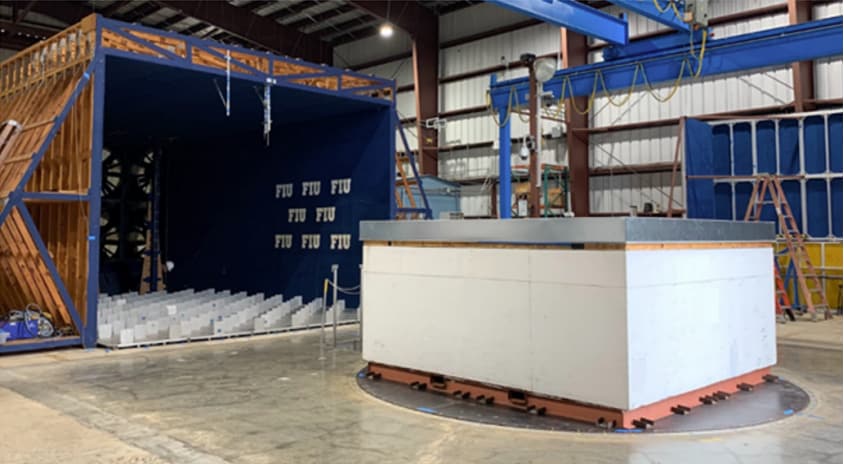
Because of the specific methodology of the ES-1 test methods for both edge metal and copings, the location of the fastener holding the cleat to the structure has been a point of discussion, or perhaps contention. The Wind tunnel testing that was conducted at FIU's Wall of Wind (WoW) in February 2022 might put fastener placement and the current testing methodology into question.
Four full-scale wind tunnel tests were performed using a contractor-fabricated, 24-gauge steel, L-shaped edge metal system with an 8 in. face, 4 in. horizontal flange, and ¾ in. drip edge. Two different 22-gauge steel cleat shapes were used—a 6 in. cleat and an 8 in. cleat with a 1 in. horizontal return (L-shaped cleats). Four different cleat-fastener locations were used—one low, one in the middle, and one high on the vertical surface, and one on the horizontal surface.
Spoiler – each of the configurations failed at 134 mph. The location of the cleat fastener was deemed to not be a critical factor in this research. For more of the specifics of this research, and for observations and suggestions for contractor-fabricated and pre-fabricated edge metal design and installation, read the Siplast white paper linked below. For more information about Siplast products, visit Siplast.com.
