

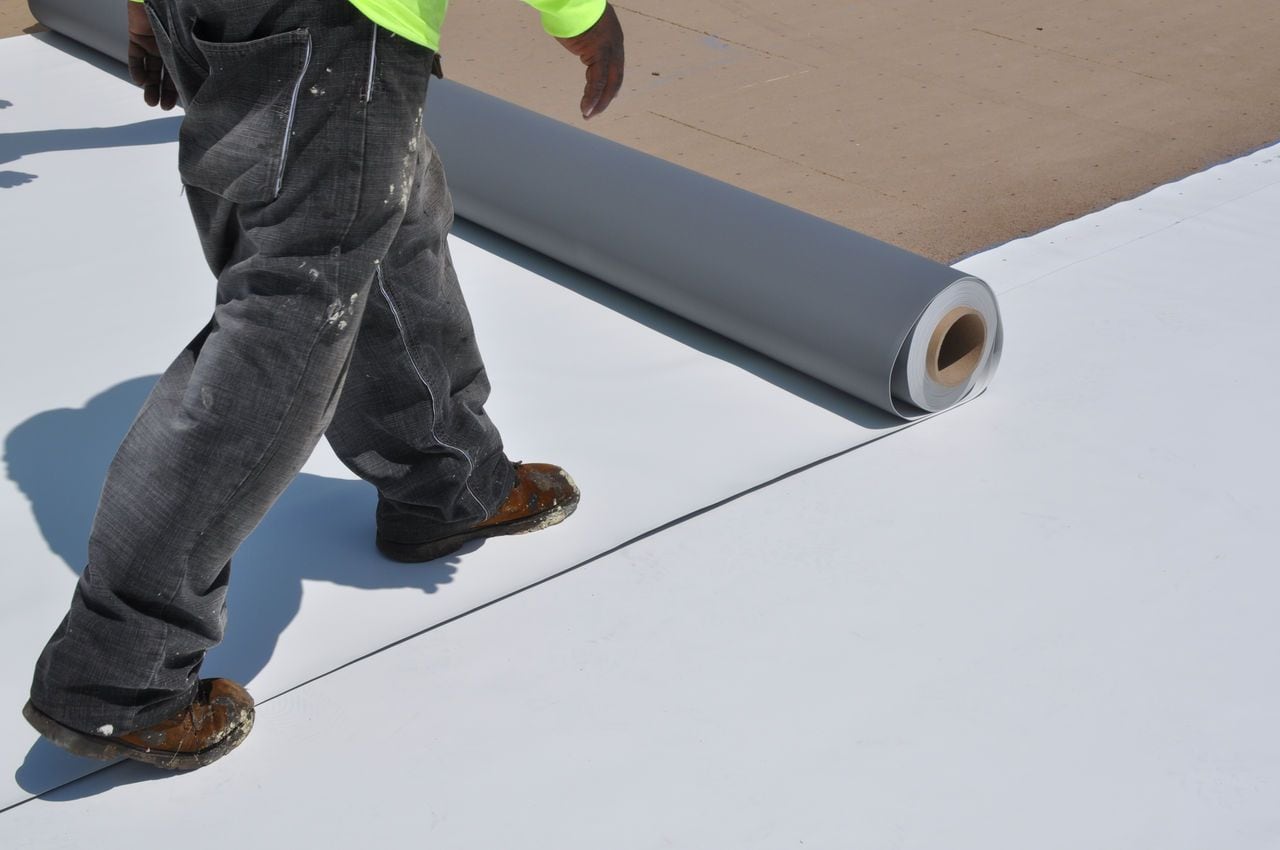
In the evolving landscape of commercial roofing, selecting the right thermoplastic membrane is more than a matter of preference—it is a decision rooted in building science and long-term performance. While Polyvinyl Chloride (PVC) and Ketone Ethylene Ester (KEE) are often discussed interchangeably, understanding their distinct chemical compositions and regulatory standards is essential for making an informed specification.
Our latest white paper, authored by Peter Gross, provides an in-depth exploration of these two critical single-ply solutions.
The Core Distinction: Chemistry and Stability
At their foundation, both membranes are PVC-based, but they are governed by different industry standards: ASTM D4434 for PVC and ASTM D6754 for KEE. The most significant differentiator lies in the plasticizer technology used to maintain the sheet's flexibility:
Standard PVC Membranes: These typically utilize liquid plasticizers that can migrate out of the material over time, potentially leading to a loss of flexibility as the membrane ages.
KEE Membranes: These utilize a high-molecular-weight solid polymer—ketone ethylene ester—which does not migrate. The goal is to achieve a in a more stable, durable sheet that retains its flexibility even under challenging environmental conditions.
Performance in Extreme Environments
While both PVC and KEE retain 90% of their properties under heat and UV, KEE membranes offer superior puncture resistance and better withstand harsh chemicals, oils, and pollutants.
Practical Applications
Whether mechanical attached adhered,, or induction welded, both membranes offer versatility across commercial and industrial projects. Furthermore, advancements in manufacturing Read the Full White Paper
To delve deeper into the technical specifications, thickness requirements, and comparative testing results of these two systems, we invite you to read the complete analysis.
PVC & KEE Roof Membranes: In-Depth Analysis of Material Composition, Standards, Performance, Applications, and Environmental Considerations
Frequently Asked Questions
Q: What are PVC and KEE roof membranes, and why should I consider them for my roofing project?
A: PVC (Polyvinyl Chloride) and KEE (Ketone Ethylene Ester) membranes are single-ply roofing membranes widely used in commercial and industrial roofing applications. Both are known for their durability, flexibility, and versatility. They offer strong protection against weather elements, UV radiation, and water ingress, making them reliable choices for protecting your building investment.
Q: Are PVC and KEE membranes similar to each other?
A: Yes, in several important ways. Both membrane types are thermoplastic, white in color, and include a significant amount of PVC polymer. They share many of the same physical performance requirements under their respective ASTM standards, and both are available with common installation methods including mechanical attachment, adhered, and induction welded systems.
Q: What industry standards govern PVC and KEE roof membranes?
A: PVC roof membranes are required by building code to meet ASTM® D4434, titled "Standard Specification for Poly(vinyl Chloride) Sheet Roofing." KEE roof membranes are required by building code to meet ASTM D6754, titled "Standard Specification for Ketone Ethylene Ester Based Sheet Roofing." Both standards cover requirements such as thickness, tensile strength, elongation, tear resistance, dimensional stability, and weathering resistance.
Q: How do the two ASTM standards differentiate PVC from KEE membranes?
A: ASTM D4434 requires that PVC membranes have a PVC polymer content in amounts greater than 50% of the total polymer content. ASTM D6754 requires that KEE membranes have a KEE polymer content of a minimum of 50% by weight of the polymer content of the sheet. While the language can be confusing, the key distinction is the dominant polymer type in each membrane.
Q: What are PVC roof membranes made of?
A: PVC membranes are typically composed of polyvinyl chloride, liquid plasticizers, sometimes solid plasticizers, additives, stabilizers, and reinforcement. They are known for their flexibility, protection against chemical exposure, and ease of installation.
Q: What are KEE roof membranes made of?
A: KEE membranes are typically composed of ketone ethylene ester, polyvinyl chloride, liquid plasticizers, additives, and reinforcement. They are known for their flexibility, enhanced protection against chemical exposure, ease of installation, and puncture resistance.
Q: What is the key compositional difference between PVC and KEE membranes?
A: The primary difference lies in how each membrane achieves flexibility. PVC-based membranes rely on liquid plasticizers, while KEE-based membranes use ketone ethylene ester, which acts as a solid plasticizer. Liquid plasticizers may migrate out of the sheet over the life of the roof, potentially making the PVC material less flexible over time. Solid plasticizers do not migrate out of the sheet. As a result, KEE membranes typically contain less liquid plasticizer than their PVC counterparts, which can lead to a more stable and durable membrane composition.
Q: How do PVC and KEE membranes compare in terms of durability?
A: Both membrane types offer excellent resistance to UV radiation and heat. The requirements for accelerated weathering and heat aging are equal for both under their respective ASTM standards, with retention of physical properties after heat aging set at 90% for each. However, differences exist in thickness requirements: PVC membranes are required to have a total thickness of 45 mils or 36 mils depending on type, while KEE membranes are required to have a total thickness of 32 mils. For thickness over scrim, all 3 types of PVC are required to have 16 mils of material above the scrim, while KEE is required to have 7 mils above the scrim.
Q: Which membrane type offers better long-term flexibility?
A: While both PVC and KEE membranes are flexible and accommodate normal rooftop movement, KEE membranes tend to maintain their flexibility over a longer period, even in more challenging weather conditions. This is largely due to the solid plasticizer (KEE polymer) not migrating out of the sheet the way liquid plasticizers can in PVC membranes.
Q: How do PVC and KEE membranes compare in breaking and tearing strength?
A: Strength requirements vary by membrane type. For breaking strength, PVC Type II requires a minimum of 55 lbf/in, Type III requires 200 lbf/in, and Type IV requires 275 lbf/in. KEE membranes require a minimum breaking strength of 337 lbf/in. For tearing strength, PVC Type III requires a minimum of 45 lbf, Type IV requires 90 lbf, and KEE requires 76 lbf. These values are directly related to the reinforcement type used in each membrane.
Q: How do PVC and KEE membranes handle chemical exposure?
A: Both membrane types offer a level of chemical resistance. KEE membranes demonstrate excellent resistance to chemicals, oils, and pollutants, making them particularly suitable for industrial settings or areas with high chemical or pollutant exposure. Notably, most PVC membrane manufacturers do not provide warranty or guarantee coverage for exposure to chemicals.
Q: Are PVC and KEE membranes fire resistant?
A: Both PVC and KEE membranes have inherent fire-resistance properties due to the PVC component within each. However, it is important to understand that fire resistance is a characteristic of the overall roofing system — including the membrane, insulation (with or without a cover board), and the roof deck — not the membrane alone. Many low-slope roof systems achieve a Class A fire-resistance rating.
Q: What types of buildings and projects are PVC and KEE membranes best suited for?
A: Both PVC and KEE membranes are widely used in commercial and industrial roofing applications. KEE membranes are especially well-suited for environments with significant chemical or pollutant exposure. Both membrane types can be installed over many different insulation systems and deck types.
Q: What installation methods are available for PVC and KEE membranes?
A: Installation methods generally include mechanical attachment, adhered, and induction welded systems (most commonly known by the trade name RhinoBond™). Specific attachment methods may vary by manufacturer.
Q: What are the environmental considerations associated with PVC and KEE membranes?
A: PVC-based roof membranes — which include both PVC and KEE — continue to face scrutiny regarding their environmental impact during manufacturing and disposal. However, advancements in material formulation have significantly reduced the quantities of harmful chemicals used. Additionally, advancements in recycling technologies are helping to enable the use of existing PVC materials in new PVC products.
Q: How do I decide between a PVC and a KEE membrane for my project?
A: The choice between PVC and KEE membranes often comes down to your specific project requirements and budget. PVC membranes are widely used for their affordability and versatility, while KEE membranes stand out for their increased durability, long-term flexibility, and enhanced chemical resistance. If your facility is in an industrial environment or requires superior long-term performance, KEE may be the stronger option. We encourage you to consult with a Siplast representative to evaluate the best solution for your specific roofing needs.
