

The Critical Role of Flashing in System Durability
In any building envelope, the areas most vulnerable to water intrusion are not the field of the roof or wall itself, but the complex transition points and penetrations. These high-risk areas (e.g., where the roof meets a vertical wall, pipes penetrate the system, or details shift geometry) are where a building’s durability is truly tested. Historically, addressing these crucial details has required labor-intensive, multi-component solutions that often sacrifice continuity and long-term performance for installation ease and convenience.
Today, building science professionals and designers are turning to a modern standard for these critical details: Siplast Parapro Flashing. Parapro is a liquid-applied Polymethyl methacrylate (PMMA) system that creates a seamless, durable, and high-performance waterproofing layer. By understanding the fundamental properties of PMMA, specifiers can move beyond the limitations of traditional flashing methods and achieve lasting waterproofing continuity across the entire building enclosure.
Deconstructing the PMMA Advantage
The core of the Siplast Parapro system is Polymethyl methacrylate (PMMA). This advanced polymer forms the primary component of the liquid-applied membrane flashing. Unlike conventional sheet flashings that rely on seams and adhesives to form a barrier, Parapro is fundamentally designed to create a continuous, monolithic seal.
Material Properties and Chemical Structure
At its base, PMMA is a highly engineered polymer, and the resins used in Siplast Parapro are formulated as two-component systems. This two-component chemistry ensures reliability and consistency upon curing. Once mixed, the liquid PMMA resin cures to form a membrane that exhibits superior characteristics crucial for demanding construction environments:
Fast-Curing: The quick-setting nature of PMMA systems reduces installation time and minimizes the period during which a detail is left exposed to weather. This is a major advantage in tight construction schedules.
Durable and Chemically Resistant: The cured membrane is highly durable, offering resistance to common chemicals, environmental pollutants, and physical wear. This durability ensures that the flashing remains intact and functional throughout the lifespan of the entire roofing or waterproofing system.
Flexibility and Monolithic Seal: Because Parapro is liquid-applied, it seamlessly conforms to irregular shapes, sharp corners, and complex penetrations where traditional pre-formed sheet goods inevitably require cutting, splicing, and seaming. This fluid application ensures a monolithic (seamless) bond, eliminating the weakest points inherent in seamed assemblies.
Unmatched UV Stability Eliminates the Need for Coverings
One of the most significant technical advantages of PMMA, and specifically Siplast Parapro, is its inherent resistance to UV radiation. Unlike many other liquid-applied and sheet membrane materials that require a protective surfacing or coating to prevent degradation from sun exposure, the PMMA used in Parapro is engineered for long-term UV exposure.
The fact that the system "does not need to be covered" translates directly into tangible benefits for project cost and schedule. It reduces the need for expensive and labor-intensive protective layers, such as metal counterflashings or dedicated UV-stable topcoats, that add both material and labor costs. While a protection layer may still be desired to safeguard against physical damage during and after construction, the core waterproofing material itself is chemically stable against the elements. This simplified detailing not only saves money but also removes an entire layer of complexity and potential failure points from the assembly.
Seamless Integration and Material Compatibility
Effective flashing must not just perform well on its own, but must integrate seamlessly with the primary roofing and waterproofing membranes. Siplast’s expertise in liquid-applied PMMA is strongly linked to its extensive history and compatibility with other material sciences.
Proven Compatibility with Asphalt-Based Systems
Siplast has successfully utilized PMMA as a flashing material for SBS-modified bitumen roofing membranes for more than twenty years. This decades-long history is driven by the PMMA’s crucial chemical compatibility with asphalt. When dealing with composite systems, ensuring that materials do not chemically react or degrade each other over time is paramount to preventing premature system failure. The established performance of PMMA with SBS membranes makes Parapro a reliable choice for long-term system integrity.
Reducing Long-Term Risk with Enhanced Continuity
Ultimately, specifying a liquid-applied PMMA system like Parapro is an essential strategy for reducing long-term failure risk. Liquid-applied PMMA drastically improves waterproofing continuity at the most complex detail points.
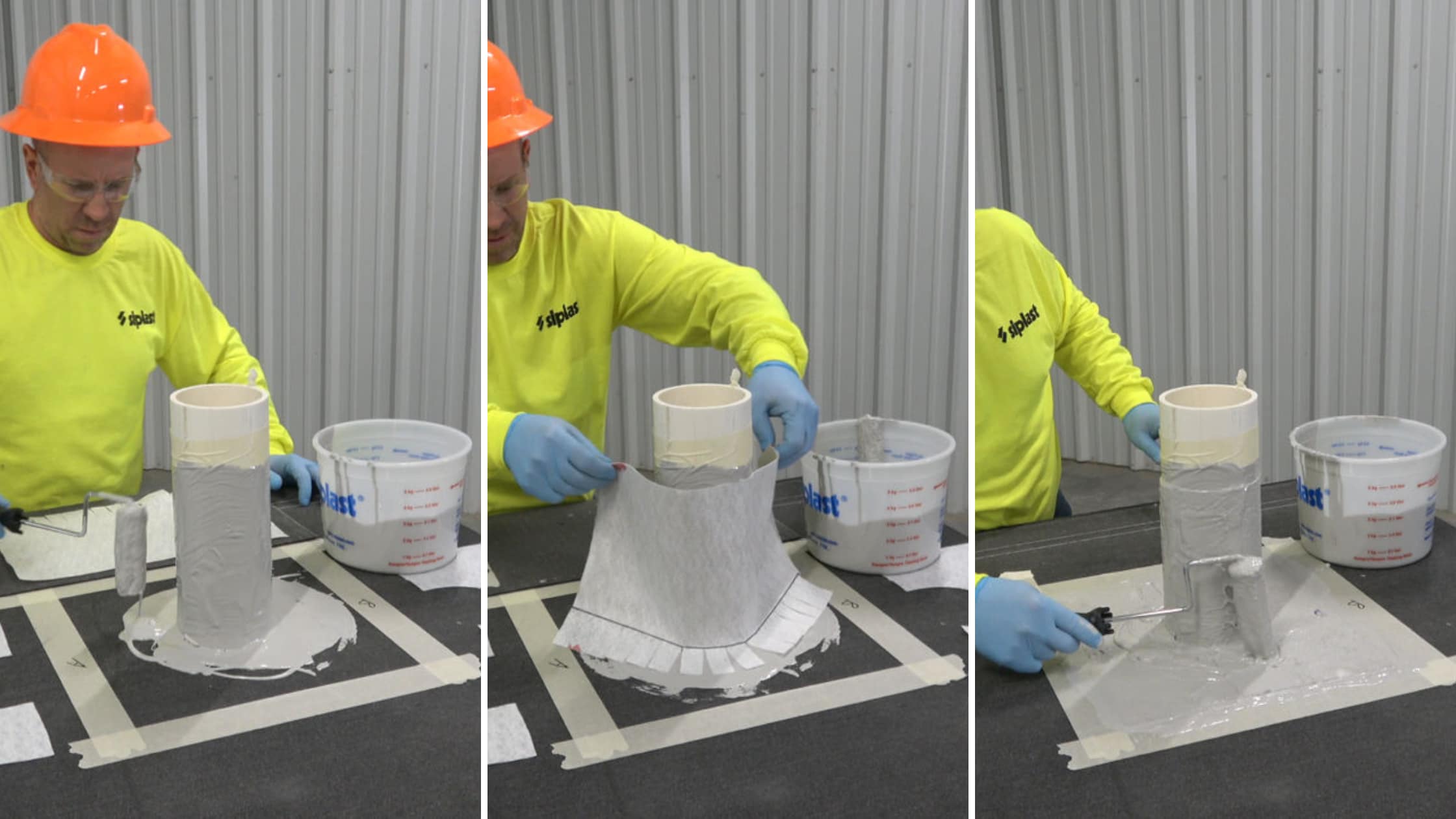
The standard installation method for Parapro—known as the Parapro Flashing Membrane—highlights how a monolithic, reinforced seal is achieved through a three-step process:
Base Layer: A base layer of PMMA is first applied to the substrate using a brush or roller.
Reinforcement: A polyester fabric reinforcement is then immediately embedded into the wet PMMA base layer. This reinforcement provides structural integrity and puncture resistance across the detail.
Finish Coat: A top layer (finish ply) of PMMA is then immediately applied over the reinforcement, encapsulating the fabric and completing the monolithic seal.
This reinforced, multi-layer process ensures that every critical detail—from parapet wall transitions to pipe clusters—is sealed completely and without seams, ensuring that the system is only dependent on the material’s long-term durability and the substrate’s integrity, significantly reducing the long-term risk of water penetration.
Parapro PMMA is the Proven, High-Performance Solution for Lasting Waterproofing Continuity
For building science professionals and designers, choosing a flashing solution is a choice about risk management. Siplast Parapro Flashing offers a significant technical advantage over traditional materials by leveraging the advanced chemical properties of PMMA.
The system delivers a fast-curing, highly durable, and chemically resistant membrane that is inherently UV stable and requires no covering. Furthermore, its proven, decades-long compatibility with asphalt-based SBS membranes and suitability for sealing complex details and geometries make it the clear technical preference for challenging projects.
By creating a seamless, reinforced, monolithic seal through its robust 3-step application process, Parapro PMMA is the proven, high-performance solution for lasting waterproofing continuity, ensuring the long-term integrity of the building envelope.
