

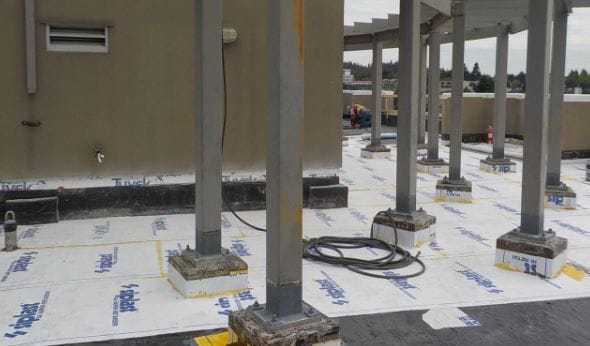
A primary function of a building envelope is to protect the interior from moisture and water intrusion, a task that's complicated by the ability of water to make its way into a building through a number of paths. Specifically, building designers must account for four types of potential water intrusion: bulk water, capillary water, air-transported moisture, and water vapor.
The roofing industry often focuses on vapor retarders, and while these are essential, more emphasis should be placed on air barriers. Fortunately, modern air and water-resistive barrier (AWB) systems are designed to provide a full spectrum of protection.
Preventing Water and Moisture Intrusion
Bulk water (i.e., rain and snow) is kept out of buildings with roof membranes and facades.
Capillary water, which is primarily a ground-based issue, involves water moving into and through the building envelope via capillary action. Foundation waterproofing and water barrier layers or components prevent this intrusion.
Air-transported moisture enters when outside air infiltrates the building envelope, while water vapor moves into buildings through diffusion across materials.
Preventing bulk water intrusion is most critical, followed by capillary water, then air-transported water. Finally, of least concern, although still important, is vapor diffusion.
The design, manufacturing, and construction industries have long excelled at keeping bulk and capillary water out of buildings. Only recently, however, has attention shifted to the importance of controlling air infiltration.
Since 2012, the International Energy Conservation Code has required all new buildings to include an air barrier—primarily to prevent conditioned air from escaping and unconditioned air from entering. But air barriers serve another critical function: limiting the movement of airborne moisture into and out of buildings.
Vapor Retarders and Air Barriers
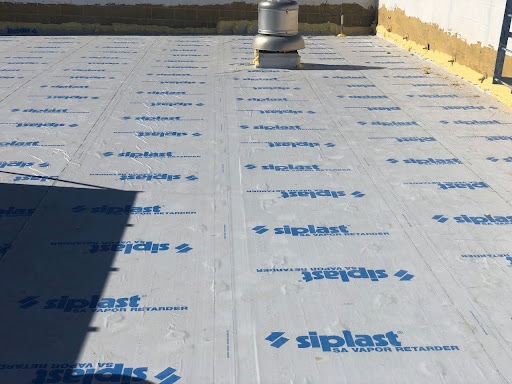
Historically, multi-ply asphalt-based vapor retarders installed above the roof deck and below the insulation also functioned effectively as air barriers. While vapor retarders are designed to reduce vapor diffusion, not all perform equally—there are three classes of vapor retarder materials, categorized by their perm ratings. The lower the perm rating, the less vapor diffusion occurs.
Most roof membranes qualify as Class I vapor retarders. For example, a single-layer, self-adhered bituminous vapor retarder typically has a perm rating of 0.03 perms. In comparison, 1/4-inch Douglas fir plywood with exterior glue is a Class II vapor retarder with a perm rating of 0.7 perms. The same plywood with interior glue is considered Class III, with a perm rating of 1.9 perms. It's important to note that these are material ratings, and proper system design and installation are critical to ensure performance.
When using a Class I vapor retarder, one key concern is that any moisture, such as construction moisture from installation practices or weather exposure, may become trapped in the roof system and unable to dry. In many cases, it's advisable to choose a vapor retarder that allows some degree of drying through diffusion. However, there are exceptions. For instance, Class I vapor retarders are necessary over indoor swimming pools or other high-humidity environments. They're also recommended over new concrete decks to prevent moisture in the concrete from migrating into the roofing system.
Siplast AWB Systems
The key takeaway is that all vapor retarders block air, but not all air barriers block vapor diffusion. In a roofing system, a vapor retarder can also function as an air barrier—provided it is fully sealed at all perimeters and penetrations and integrated with the wall air barrier to prevent air from bypassing the vapor retarder layer.
Siplast SBS-modified bitumen roof assemblies and PMMA-based systems serve as both vapor retarders and air barriers. The waterproofing characteristics of SBS-modified asphalt help ensure water tightness, prevent water intrusion and leaks, and provide dependable performance over the long term. PMMA flashing resin and roof membrane resin provide a reinforced waterproofing flashing membrane or roof membrane system and are specifically designed for exposed roofing and waterproofing applications not subject to pedestrian or vehicular traffic.
Moving Forward
There's always more to learn when it comes to the building science behind roof systems. Traditionally, roofs incorporating vapor retarders have used asphaltic materials, such as a single-layer modified bitumen sheet or a double mopping of asphalt, installed directly to the deck or over a mechanically fastened hardboard. But considering that air movement transports 10 to 100 times more moisture than vapor diffusion, it may be time to rethink this approach. Using a Class II or III vapor retarder, such as a hardboard or plywood deck, could serve as both an effective air barrier and a layer that allows for controlled drying.
The wall industry has embraced this concept for years. For example, gypsum-fiber board, with a perm rating of approximately 24 to 30 (depending on thickness), can be mechanically fastened to a steel deck and sealed at joints and transitions to create an air barrier that still permits some drying. It may be time for roofing professionals to take note.
Siplast AWB systems reflect this integrated approach, prioritizing the specific function of the building envelope based on each project's unique requirements. Every element of a Siplast roofing solution is selected with careful consideration of multiple factors: climate zone, wall assembly design, building type and use, interior environment, and detailed construction features. This holistic design philosophy helps ensure optimal material selection, system performance, and long-term durability.
