

Except in extremely arid climates, water vapor is always present in the air around us. When air comes into contact with a cold surface, water vapor condenses as a liquid onto the surface, a phenomenon known as condensation. Even in the absence of a cold surface, condensation in the form of mist or fog can occur anytime there is a sudden drop in air temperature. That's because air is capable of holding more water at higher temperatures than at colder temperatures.
Condensation can occur on both the interior and exterior surfaces of a building, including the roof. Addressing roof condensation should be an essential part of building design.
Relative Humidity
At any temperature, the air can hold only a certain amount of water. The amount of water present in the air is measured as a percentage of that maximum amount. For most people, 50 to 60 percent relative humidity is very comfortable, while anywhere from 30 to 70 percent is generally tolerable. Relative humidity below 30 percent is noticeably dry and above 70 percent is classified as humid.
Let's compare Miami and Phoenix to see how relative humidity comes into play. The relative humidity in Miami is likely to be above 65 percent, which means the air is holding more than 65 percent of the moisture it is capable of holding. In contrast, the air in Phoenix is very dry, with 35 percent relative humidity. While condensation is likely to occur in Miami, little condensation is likely to occur in Phoenix due to the dry air.
Dew Point
By contrast, the dew point depends on both relative humidity and ambient temperature—that is, the amount of water vapor in the air and the air temperature. The dew point is the specific temperature at which, given a certain humidity, water vapor begins to condense.
Let's consider Miami and Phoenix again as two extremes. In the summer, Miami's relative humidity can reach 85 percent at a temperature of 80 degrees Fahrenheit. But only a slight temperature drop could result in 100 percent relative humidity and cause condensation form. At the same temperature in Phoenix (80 degrees Fahrenheit), the relative humidity could be 35 percent. The temperature drop would have to be much more before condensation could form.
Condensation and Roof Design
The roofing system is a crucial part of the building envelope, alongside the foundation and walls, and is subject to many of the same hazards from water condensation. The insulation layer of a roofing system is designed to resist heat loss or gain from the outside, depending on the season. Inside this layer, temperature gradually changes until it matches the outdoor temperature. This change in temperature across the insulation is known as the temperature gradient.
Condensation can reduce the R-value of the insulation by displacing the air within it with water. This moisture can lead to premature deterioration of roofing components, such as rotting wood or rusting metal, including structural elements. Additionally, condensation promotes unwanted biological growth, like mold.
Energy efficiency upgrades that include roof replacement can inadvertently lead to unwanted condensation through stained ceilings and other unwanted manifestations of condensation. Upgrades in windows, doors, and weather-stripping could reveal latent moisture previously hidden by air leaks across the building envelope.
Penetrations for vents and other details that involve cutting holes through the insulation require close consideration in roof design. Gaps around penetrations allow interior air to move up through the roof system, leading to significant condensation, especially in cold climates. The billowing effect of a mechanically attached roof can exacerbate the potential for roof condensation through air drawn into the roof system. An adhered roof membrane may limit this hazard.
Beyond location, intended use can also impact potential condensation both inside and outside the building envelope, including the roof. Factors that can adversely affect temperature and humidity, and therefore hygrothermal performance of the envelope, include: a dramatic change in the number of occupants, the addition of a kitchen or cooking equipment, the addition of a locker room workout area or shower, or even seemingly insignificant factors such as an aquarium or stored wood for a fireplace. Even changing the color of the exterior components could contribute to more or less solar gain and effectively change the dew point location within the building envelope, leading to unwelcome condensation and potential damage.
Preventing Roof Condensation
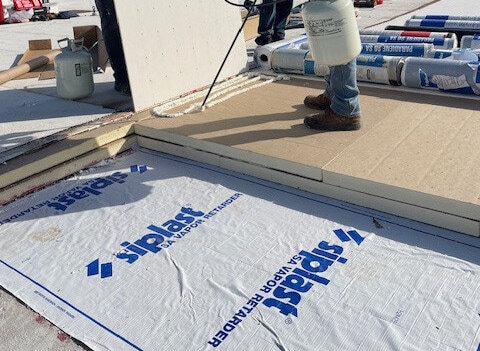
To prevent roof condensation and other adverse effects of water vapor intrusion, interior air must be prevented from moving into the roof. Vapor retarders can play a crucial role in mitigating potential damage from roof condensation by minimizing the passage of water vapor through roof insulation layers. Vapor retarders are typically recommended above heated structures in areas where January temperatures typically dip to 40 degrees Fahrenheit or colder, or in any scenario where significant vapor occurrence, such as buildings with elevated indoor relative humidity levels.
One method to limit air movement into a roof includes using two layers of overlapping foam insulation. Another method is to place a vapor retarder or air barrier on the warm side of the insulation. The vapor retarder/air barrier can prevent water vapor from reaching the location where it can condense.
It should be apparent that a holistic approach is the key to good building envelope design. At the same time, specifics in product selection and insulation methods will vary with each project. Incorrectly specified or installed vapor retarders can adversely impact the performance of roofing membranes. Guesswork should never enter into the process. Instead, obtaining expert input from experienced building envelope consultants can minimize potential damage from condensation.
Learn more about how vapor retarders play a crucial role in controlling moisture and preventing condensation.