An Introduction to Air and Water-Resistive Barriers
Moisture management is perhaps the most perpetual damage function of a building enclosure, which is why air and water-resistive barriers are critically important. In moist and dry climate regions alike, if an enclosure fails to prevent bulk water intrusion or does not manage condensation risk, moisture can linger in an assembly, which can lead to failures like:
Deterioration of the building enclosure
Compromission of the building structure
Mold growth
Pest damage
Indoor air contamination
And make no mistake: Water will get into an enclosure. It might be through natural events. It may be through leaks in pipes. It may be through condensation created by air infiltration or the difference between the internal and external climate conditions. Regardless, design professionals should anticipate these issues and properly design building assemblies to manage moisture.
Central to every building's moisture management strategy is preventing bulk water intrusion. Of all the ways moisture can damage a building and pose a health threat to occupants, if water gets in, nothing else will matter. This is where water-resistive barriers come into play.
The Proper Barrier Terminology
A water-resistive barrier is a material or system installed within a building assembly to resist the intrusion of water (i.e., moisture in liquid form). Note that this definition makes no mention of air or water vapor—just water. The International Code Council and the American Society for Testing and Materials, among others, use the water-resistive barrier terminology.
Contrast this with the term weather-resistive barrier. Some building professionals conflate the two or claim both terms are interchangeable. Others contend that weather-resistive barriers connote a more expansive type of enclosure barrier, perhaps addressing water along with air and perhaps vapor. At best, the term weather-resistive barrier is ambiguous. As such, it is best to avoid it.
Here's how water-resistive barriers compare to complementary barriers that can work together as part of a high-performance building enclosure:
Water-resistive barriers prevent liquid water penetration. They are usually vapor-permeable, so the assembly can dry.
Air barriers restrict the flow of air through the building enclosure and may or may not coincide with the water-resistive barrier.
Vapor barriers control water vapor diffusion through an assembly (independent of vapor-laden air movement).
Air and Water-Resistive Barriers
In modern practice, one product can sometimes fulfill more than one barrier role. For example, Siplast often uses the term "air and water-resistive barrier" to clarify the dual function of the product as both an air and water-resistive barrier.
Moreover, air barriers and vapor barriers are often confused by design and construction professionals. Be wary of the term air and vapor barrier. This is often misused and misunderstood. If someone is asking for a "permeable air and vapor barrier," that's a red flag, because by definition, it is seeking to prevent both air and vapor migration.
Types of Barriers
Water intrusion threats are imposed on the building enclosure in various ways, including bulk water intrusion, capillary action, groundwater and hydrostatic pressure, freeze-thaw cycling, and standing water conditions.
As such, there are several basic types of water-resistive barriers, each of which can contribute to a comprehensive system:
Building papers. One of the oldest water-resistive barrier types, they can come in the form of asphalt-impregnated kraft paper or felt and are often referred to as "tar paper." This type of barrier is relatively low cost and simple to install, providing water resistance. Note that these products may have a relatively low vapor permeance when dry but are highly vapor permeable when wet.
Sheet-applied products. This type of water-resistive barrier can be categorized as plastic "house wraps" and includes spun-bonded polyolefin products. They come in large rolls and must be fastened over sheathing. These sheet products are highly water-resistant but typically vapor permeable. They're often lightweight and widely available. With proper installation, this type of water-resistive barrier may serve as an air and water-resistive barrier. These products are vulnerable to ultraviolet (UV) exposure and wind damage and should not be left exposed during construction.
Self-adhered membranes. These are sheet products manufactured with an adhesive backing. They're applied directly to a prepared substrate. This type of water-resistive barrier includes rubberized asphalt, butyl, and acrylic formulations. While they tend to be more expensive than house wraps, they're also more robust and durable, which can serve well for complex detailing (e.g., transitions or around windows). This type of barrier can often serve as an air and water-resistive barrier; however, vapor permeability can range considerably.
Fluid-applied membranes. This type of water-resistive barrier includes various liquid coatings (e.g., spray-, roller-, or trowel-applied) that are applied wet and then cure to form seamless barriers. Often elastomeric or polymer-based, they have the advantage of providing monolithic coverage, bridging cracks and gaps without seams. Such products are a good fit for irregular geometries, penetrations, or complex transitions but also require skilled labor. These products can often serve as air and water-resistive barriers. Note that many are vapor permeable, though some are vapor impermeable.
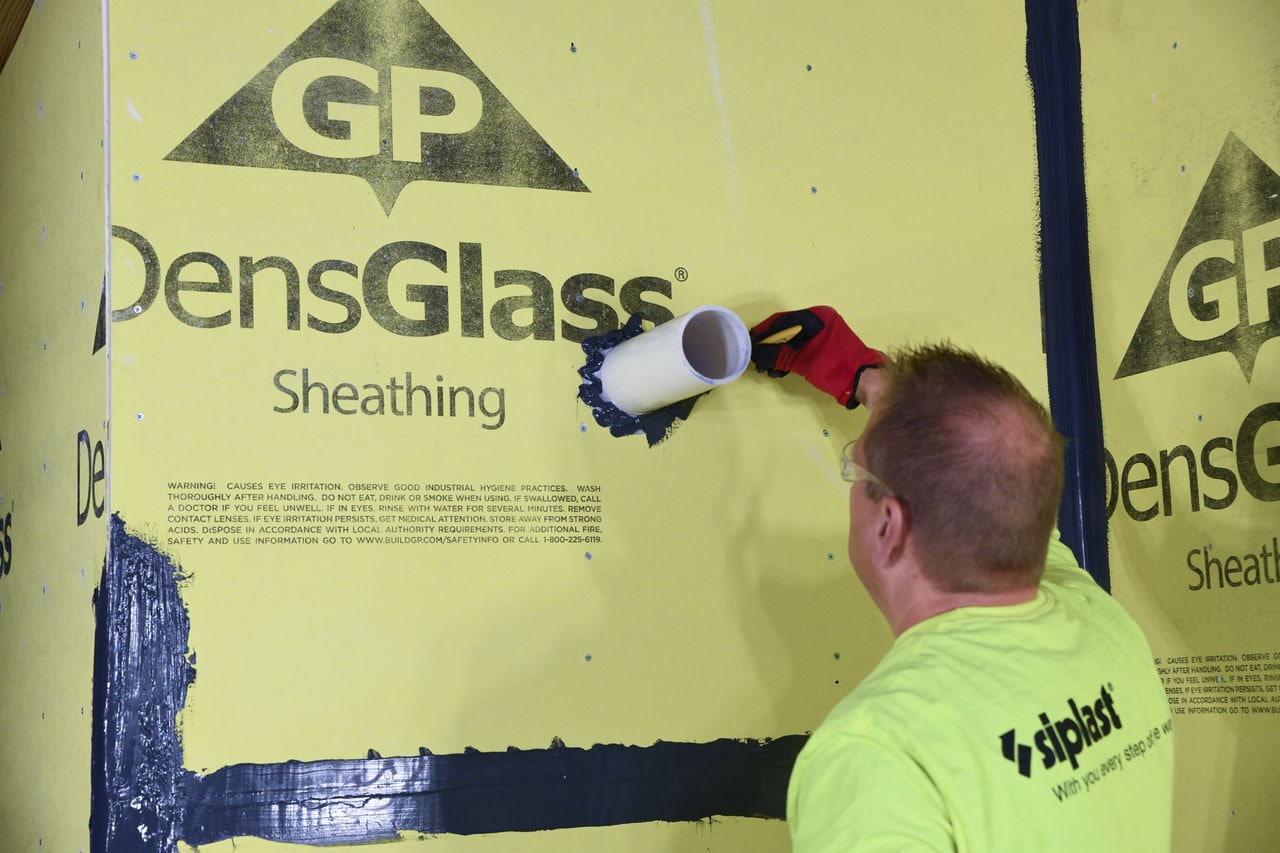
Integrated sheathing products. In recent years, the industry has seen a rise in rigid panel products consisting of plywood, oriented strand board, and/or gypsum sheathing that are factory-laminated with an integrated water-resistive barrier layer. Panel joints are sealed with proprietary tapes or liquid sealants. The motivation is to reduce sequencing issues and provide greater quality assurance. With proper installation, these products can also serve as air and water-resistive barriers but often allow a considerable degree of vapor permeance to ensure drying is allowed (which is critical due to what the panels are comprised of).
Some industry professionals might point out that certain closed-cell spray polyurethane foam (SPF) products, as applied to exterior sheathing, can exhibit highly water-resistant properties and a low water absorption risk. While this is true, SPF products are UV-sensitive, can be damaged by pests, and generally, may degrade over time. As such, SPFs should not serve as dedicated water-resistive barriers.
Design Considerations for Barriers
Proper design and quality installation are critical to the performance of barriers. Key considerations may include:
Continuity. The barrier must form a continuous protective layer across the enclosure. Overlaps, transitions, and how the barrier interacts with flashing at openings, roofs, and penetrations are all critical.
Drainage. The system typically allows drainage planes. Assume constant moisture and plan for drainage.
Drying. Never trap moisture in an enclosure. The system should allow drying, but there are caveats. In cold climates, vapor-permeable barriers may facilitate assemblies drying to the outside; whereas, in hot-humid climates, some assemblies may benefit from barriers with lower permeability to limit inward vapor drive.
Appropriate durability. In some circumstances, the barriers must withstand UV exposure, wind loading, or job site handling until cladding is installed. Keep these specific needs in mind.
Compatibility. Sealants, adhesives, flashing, and tapes must be chemically and physically compatible with the barrier system.
Proper detailing and installation. Complex details are high-risk areas for failure. Appropriate detailing and installation in accordance with manufacturer requirements and recommendations are critical. Designs should also anticipate strategies for inspection and repair before cladding is installed.
Performance verification. As a means of quality assurance, performance testing should be specified and executed on every job.
A successful barrier system ensures continuity, drainage, durability, compatibility, and code compliance while accounting for climate and constructability. The effectiveness of these systems depends not only on the product types chosen but also on proper detailing and installation.
For more information on air and water-resistive barriers, see Siplast's Ultimate Guide to Commercial Air and Water-Resistive Barriers.
