

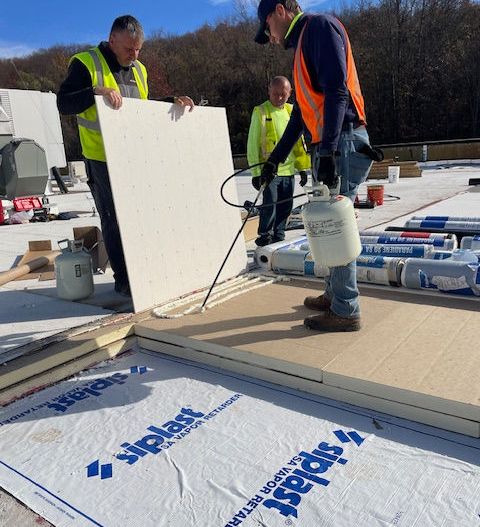
Building owners and design professionals are continually seeking ways to enhance the energy performance of buildings. One way to do so is through insulation, which can slow the transfer of thermal energy (i.e., heat) through a building assembly.
Generally, more insulation means less heat transfer. However, a haphazard approach to distributing insulation throughout a building enclosure may lead to inconsistencies, which could undermine the impact of the insulation and may even lead to condensation risk and potential damage.
A thoughtful approach to insulation should focus on establishing an integrated system of insulation throughout the entire building enclosure. This is one common example of a thermal barrier.
Understanding Thermal Barrier Systems
More broadly, a thermal barrier can be defined as the control layer of a building enclosure that's primarily dedicated to resisting the transfer of heat between the interior and exterior environments.
Every building product or material exhibits a certain rate at which it allows heat to transmit through it. Some building materials (e.g., steel and glass) transmit heat quickly, whereas other materials (e.g., wood and gypsum) transmit heat much more slowly. Yet, some materials are introduced to an assembly for the dedicated purpose of increasing the overall insulation quality of the assembly (e.g., thermoset plastics, such as polyisocyanurate or batts consisting of spun-glass fibers). This dedicated insulation layer serves as the primary thermal barrier.
How Is Insulation Performance Measured?
Understanding thermal barriers requires a familiarity with a few key performance metrics:
Thermal Transmittance (U-Factor)
The movement of heat through a product or material occurs as a flux, meaning it's always happening to some degree. This heat flow rate can be measured as heat transmission per unit time through unit area by unit temperature difference between two defined surfaces of a material or assembly (i.e., Btu/hr•ft²•°F or W/m²•K). This is called the U-factor. A lower U-factor means better insulation.
Thermal Resistance (R-Value)
Insulation's effectiveness is usually conveyed in terms of thermal resistance, which is the inverse of thermal transmittance (i.e., hr•ft²•°F/Btu or m²•K/W). As such, the higher the R-value, the more effective the insulation.
In addition to U-factor and R-value, it should be pointed out that fenestration components of a building enclosure—such as windows, storefronts, curtainwalls, and other types of glazing products—are typically transparent or translucent and function as solar apertures, meaning they collect solar energy. To measure this thermal effect, we have one additional metric:
Solar Heat Gain Coefficient (SHGC)
This is the ratio of the solar heat gain entering the interior space through the fenestration to the overall incident solar radiation. Solar heat gain includes directly transmitted solar heat and absorbed solar radiation, which is then reradiated, conducted, or convected into the interior space.
Types of Thermal Barriers
At the most basic level, there are three types of thermal barriers:
Insulation-Based Thermal Barriers
This is the most common type of thermal barrier. It is comprised of a coordinated system of dedicated insulation layers, which can take on three forms:
Cavity insulation placed between structural framing members (e.g., fiberglass batts, cellulose, or mineral wool).
Continuous insulation (CI) solutions that are independent of the building's structure to establish a greater degree of continuity (e.g., rigid foam board or spray polyurethane foam).
Glazing assemblies or fenestrations in a building enclosure (e.g., windows, skylights, or storefront/curtainwall systems), which behave differently than opaque assemblies, as they constitute an aperture that allows solar radiation to penetrate a building enclosure.
Mass-Based Thermal Barriers
Some materials mitigate heat exchange not primarily through thermal resistance but through thermal storage capacity, which moderates indoor temperature swings. Certain thermally massive material (e.g., brick, concrete, or adobe) will transmit heat away from its surface and distribute the thermal energy throughout itself, only to release the heat once its adjacent environmental conditions modulate to become cooler than the material.
Mass-based thermal barriers are typically used in buildings optimized for passive solar design, where mass helps store daytime solar income and release it at night. Generally, a "thermal barrier" implies an insulation-based system as previously noted.
Radiant Barriers
A complete depiction of thermal barriers should technically include radiant barriers as a specialized type. Radiant barriers are typically comprised of reflective foil surfaces installed in wall cavities or attics. They work by reducing radiant heat transfer, especially in hot climates.
Unlike insulation products or materials, radiant barriers do not slow conduction but reflect radiant thermal energy instead. Again, unless otherwise specified, assume the term "thermal barrier" is in reference to an insulation-based system.
Hybrid Solutions
Hybrid Thermal Barriers
In some cases, building products may consist of components such that multiple types of thermal barriers are simultaneously accomplished. These may be referred to as hybrid thermal barrier systems.
Foil-faced insulation board may serve as an insulation-based system while providing a radiant barrier. Insulated precast concrete panel products will integrate an insulation-based thermal barrier into a thermally massive enclosure assembly.
When considering hybrid thermal barriers, design teams should carefully consider the performance characteristics of integrating multiple thermal barrier types.
Hybrid Control Layer Systems
It's possible for a thermal barrier system to also function as another control layer. For example, a properly taped and sealed continuous insulation system may also function as the assembly's air barrier. Certain insulated metal panel and insulated precast concrete systems can serve as thermal, vapor, air, and water-resistive barriers.
Key Design Considerations for Thermal Barriers
Thermal Bridging
Like all barriers within a building enclosure assembly, continuity is critical for performance. However, there may be conditions where a building component with high thermal conductivity cuts through or bypasses the insulation-based thermal barrier, creating a thermal "short-circuit" around the insulation and lowering the effective R-value of the assembly. This is known as thermal bridging, and it is a common phenomenon on building projects.
Consider wall studs interrupting cavity insulation, balcony slabs extending through exterior walls, beams extending through a wall, or metal window frames—all of these are common examples of thermal bridges, and such conditions can lead to increased thermal exchange, "cold spots" on interior surfaces (which can cause condensation and mold), and reduced overall energy efficiency.
To combat thermal bridging, utilize continuous insulation systems, thermal breaks (i.e., components with low thermal conductivity that are inserted between conductive elements to impede the flow of heat), and/or detailing strategies to maintain the continuity of the thermal barrier.
Continuous Insulation
Practically, there is no such thing as truly continuous insulation. The term denotes more of an approach than an outcome, because there's usually something holding the insulation in place.
The idea behind continuous insulation is that the dedicated thermal barrier is oriented outboard (or, in some cases, inboard) of the building's structural system and, as such, can achieve a much greater degree of continuity compared to a solution that provides non-continuous insulation between structural members, such as cavity insulation solutions.
Moisture Management
Ill-conceived insulation solutions can trap moisture, which may lead to rot, mold, or freeze–thaw damage. Some materials (e.g., closed-cell spray foam or foil-faced foam) may function—advertently or inadvertently—as vapor barriers. Assemblies must allow for drying on at least one side. As such, carefully consider the unique vapor profile of every assembly.
It's also worth noting that some insulation products (e.g., fiberglass batts) lose effectiveness if they get wet, while others (e.g., mineral wool) are more resilient.
Airtightness
A thermal barrier may or may not serve a dual purpose as an assembly's dedicated air barrier. Nevertheless, vapor-laden air movement through a thermal barrier can decrease the effective R-value dramatically, and it introduces potential moisture-related risk factors, such as condensation, which can lead to rot and mold growth.
Proper Thermal Barriers Are Worth the Investment
With proper design and construction, thermal barrier systems can impede unwanted heat flow, increase energy efficiency, improve thermal comfort, reduce a building's operating costs, and enhance its durability.
