

This article is Part 1 of a five-part educational series developed to meet continuing education (CE) credit requirements. Go to Article 2
It is the phone call that every architect and builder dreads: a building performs well on paper. The energy model looks good. The products are compatible and specified correctly. The contractor is experienced. And yet – a few years after completion, the building enclosure fails. The roof leaks at the parapet. Moisture damage appears at the base of the curtainwall. Latex paint is bubbling and you are pretty sure you see mold in the corner.
In each case, it is determined that the culprit was not a bad product. Rather, it turned out to be a missing connection between enclosure systems that were designed in isolation. The building enclosure is not the composite of separate assemblies. It is one continuous system, and it either works as a whole or it fails at the seams.
The whole-enclosure mindset.
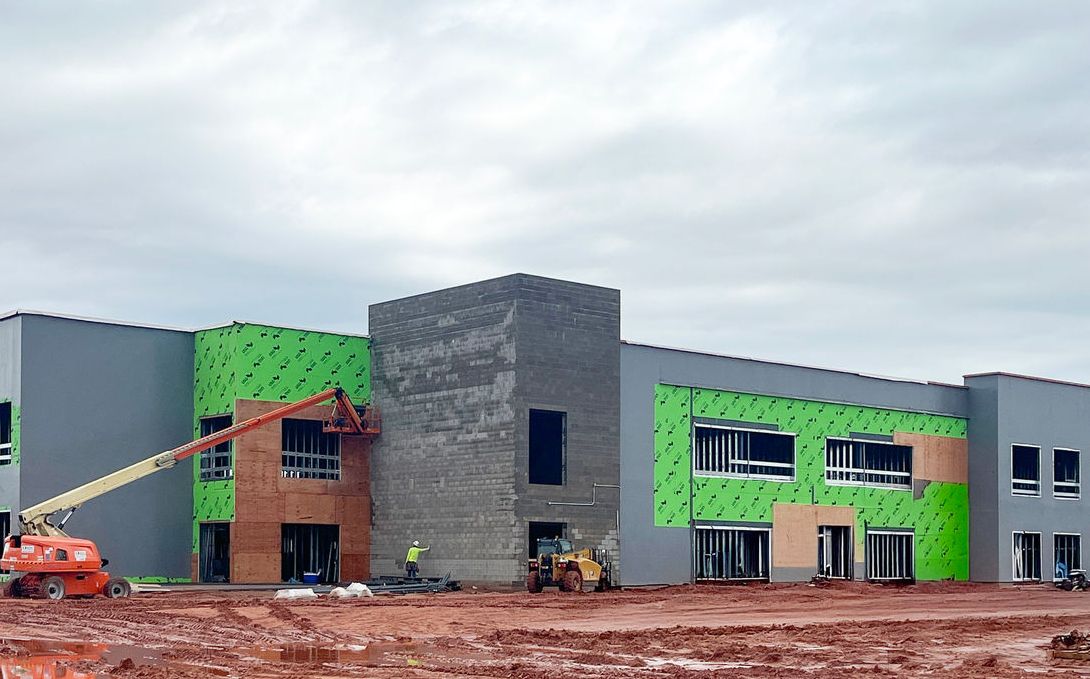
When I initially define the “building enclosure” to my students or industry professionals, I will often break it down to its essence: the physical boundary separating the conditioned interior from the exterior environment – which entails the roof assembly, above-grade wall assembly, below-grade assembly, and fenestration assembly. In practice, these components are often designed by different consultants, specified in different sections of the technical specs, and installed by different subcontractors. Such fragmentation might be efficient, but it is also the root of many enclosure problems. It quickly becomes clear that a more accurate definition of the building enclosure is through the lens of its ability to effectively manage water intrusion, air movement, vapors diffusion, and heat flow. Every component of the enclosure has a job and must be considered in context to ensure continuity of function. Simply put, we should consider every component of the building enclosure as part of an integrated and coordinated system. Call it a whole-enclosure mindset.
The four control layers.
Every building enclosure should be approached in terms of four crucial “control layers”:
Bulk water control layer: This is the primary defense against water intrusion. In a roof assembly, this is the membrane; in the wall, it may be a dedicated water (or weather)-resistive barrier (WRB) or cladding system; below-grade, it may be a waterproofing membrane. The water control layer must be lapped, sealed, and transitioned continuously from plane to plane. A gap at the parapet or at the foundation wall-to-slab interface are examples where properly managed transitions can better ensure continuity of bulk water control. When this control layer fails, it can lead to deterioration of the building enclosure, compromission of the building structure, mold growth, pest damage, and indoor air contamination. The damage from bulk water intrusion is often quite evident, which prompts measures to rectify the failure.
Air control layer: This is arguably the most consequential layer for both energy performance and moisture management because air movement carries far more moisture through a building enclosure than vapor drive. The dedicated air barrier must be defined, designated to a specific material in each assembly, and connected at every transition. This is so important that the latest editions of ANSI/ASHRAE/IES Standard 90.1, the International Energy Conservation Code (IECC), and the International Green Construction Code (IgCC) all call for performance verification of the air barrier through whole-building pressurization testing in accordance with ASTM E779.
Vapor control layer: This is the most misunderstood of the four layers. It is critical to note that vapor control is not the same as air control; that the vapor control layer often will permit some degree of vapor diffusion through it and the appropriate permeance of this (so-call) vapor barrier depends on climate zone and assembly configuration. In many assemblies, the vapor barrier is also the air control layer – but that is not always intentional or correct, and it adds to the confusion and conflation among many professionals.
Thermal control layer: This is the enclosure's defense against conductive heat flow (in either direction). In application, the optimal strategy is to achieve “continuous insulation” – insulation installed without interruption across the structural framing rather than between it. This distinction matters because so-called “cavity insulation,” whether batt or spray foam installed between steel studs or wood framing, is compromised by every framing member it contacts through a phenomenon called thermal bridging. This matters a lot. Steel is a particularly conductive material and a steel stud wall with R-19 batt insulation between the framing may deliver an effective whole-assembly R-value closer to R-8 once thermal bridging through the framing is accounted for. Continuous insulation installed on the exterior face of the structure sidesteps this problem by keeping the framing within the thermal boundary rather than embedded in it. But keep in mind that true continuity is still challenged by support systems and transitions – the latter of which is too often overlooked. For example, where roof insulation terminates and wall insulation begins, a gap in the thermal control layer is almost inevitable unless the detail is drawn explicitly and the continuity of the insulation is carried through the transition.
Where building enclosures often fail: the transitions.
Conceptually, it stands to reason. It is not our well-designed and specified building enclosure assemblies that fail; rather, failure occurs where these assemblies come together.
When it comes to transitions, there are specific instances that every building team should clearly address in their design documentation:
Roof-to-wall transitions (e.g., parapets, through-wall flashings, copings, eaves). Thes transitions are where the control layers of the roof assembly must hand off cleanly to their counterparts in the wall assembly. Simple enough. Until structural conditions come into play. Thermal bridging abounds; air and vapor barriers may attempt to wrap around complex geometries; and poorly conceived eave details and phenomena such as ice dams can invite capillary action.
Wall-to-foundation transitions (e.g., the base of the wall, sill conditions, where an above-grade WRB meets below-grade waterproofing). Where the wall meets the foundation is a zone that often falls into a specification gap between the trades handling the wall and the waterproofing subcontractor. Details can mitigate this disconnect with explicit callouts along with purposefully redundant “belt and suspender” solutions. However, care should be taken to ensure that moistures is never trapped within an enclosure assembly.
Building openings (e.g., windows and doors). Every rough opening for a window or door presents a unique transition challenge. Typically, a door or window is comprised of a manufactured system complete with its own necessary control layers. The challenge is fitting up the door or window system with the encompassing building enclosure. This logic extends to storefront and curtainwall systems.
Miscellaneous penetrations and interruptions (e.g., pipes, conduit, structural elements, and mechanical equipment). Every building will present specific conditions where a building component must pass through any combination of the enclosure’s control layers. Yet, in many instances, these conditions lack the rigorous detailing and coordination exhibited for other transitions for a very basic reason: they are may not have been previously identified or may have emerged in the field due to changes. These are the wildcard situations that can present consequential conditions with limited opportunities to mitigate poor performance outcomes.
In a very real sense, the enclosure is only as continuous as its least-detailed transition. Perhaps this resonates if you have experienced any of these failures in the field.
The integrative process solution.
Enclosure failures at transitions are often less a failure of knowledge than a failure of coordination. Each specification section is written and reviewed separately, by different professionals, at different times. No one is explicitly responsible for the transition between them. Too often the transitions are an afterthought. This can be rectified in a few ways:
Better frameworks. This is precisely where better processes can advance the whole-enclosure mindset and mitigate failure of the control layers. For instance, the LEED v5 Building Design and Construction (BD+C) rating system is designed to address this in two ways. First, during early design, the Integrative Design Process credit (IPc1) call for an integrative team to convene early and consistently pursuant to high-performance, cost-effective, and cross-functional project outcomes through an analysis and planning of the interrelationships among building systems. Note that the enclosure decisions made in schematic design (insulation strategy, air barrier continuity, waterproofing approach) have a disproportionate effect on operational energy, embodied carbon, and resilience outcomes – far more than product substitutions made during construction documents. Secondly, LEED v5 BD+C’s Fundamental Commissioning prerequisite (EAp3)requires building enclosure criteria to be explicitly noted in the Owner’s Project Requirements (OPR) and adopts the building enclosure commissioning requirements of ANSI/ASHRAE/IES Standard 90.1-2019/2022 by reference.
Better tools. Building Information Modeling (BIM) gives design teams a practical tool for identifying enclosure discontinuities, before they become field problems, by allowing the air, water, vapor, and thermal control layers to be modeled as discrete, traceable elements across all three enclosure planes simultaneously. Clash detection workflows can flag conditions where, for instance, a structural element interrupts the continuous insulation layer – or similar conflicts that are easy to miss when details live in separate drawing sets reviewed independently.
Better detailing. Documenting transitions well begins with a shift in how architects organize their drawing sets. Rather than treating the roof, wall, and foundation condition as separate details, they should be approached but as a composite detail that traces the controls layers continuously from the roof down through the foundation, with every material identified, every lap and seal called out, and every responsibility clearly assigned. A useful discipline referred to as the “pen test” (sometimes called the "red line test") literally traces a continuous line for each control layer across the entire building section and seeks to treat any break in that line as an unresolved design issue rather than a field decision.
Better specifications. Take the ambiguity out of the project manual. Identify which products in each assembly are serving as the water, air, vapor, and/or thermal control layers and require the contractor to verify continuity at the transitions – and clarify how.
Better processes. One of the easiest solutions to improve project outcomes regarding building enclosures is to allow for ample time for a second pair of eyes. Providing an internal or external quality assurance/quality control (QA/QC) review allows for opportunities for and potential insights that come from a different perspective by another qualified professional. For more rigorous services related to oversight as well as performance verification, project teams should engage enclosure commissioning (BECx) services for design and construction phase services. Even on projects not pursuing LEED, BECx is rapidly becoming a code requirement and is the single most reliable way to catch transition failures before they become compounded problems post-occupancy.
The whole-enclosure mindset emerging as the new norm.
Returning to the building that performed on paper but failed in the field, the failure was the siloed approach to the enclosure and unresolved transitions that resulted. As energy codes tighten, as LEED v5 formalizes integrative design requirements, and as our tools and processes improve, the whole-enclosure mindset is no longer a best practice favored by enclosure specialists. It is becoming the baseline expectation for every design professional who puts their stamp on a building set. Every component of an assembly plays a role; however, the enclosure only performs when it is designed as one system.
